Highly efficient PCB copper pour coverage method
高效的 PCB 銅面覆蓋法
A geometry-based coverage strategy designed to reduce brush travel distance and overlap when filling PCB copper regions.
Publication details
“Highly efficient PCB copper pour coverage method.” Minghsin Journal, Vol. 47, pp. 1–8 (2024).
The study proposes a geometric brush-coverage strategy for triangular and certain quadrilateral PCB copper regions, aiming to reduce stroke overlap and travel distance.
Coverage method
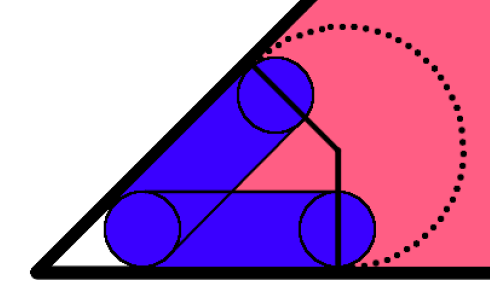
The method first covers the polygon interior with suitable brush paths, then recursively fills the remaining corner gaps with V-shaped strokes.
Results
With a minimum brush radius of 1 unit, the study generates 1,000 random triangles of area 10K square units, then scales their lengths by 10 and 100 (areas 1M and 100M). The comparison uses the 2020 coverage method cited in the paper. Lower values are better for both metrics.
| Area | This study | Comparison |
|---|---|---|
| 10K | 152.36% | 220.50% |
| 1M | 154.77% | 578.28% |
| 100M | 154.98% | 1753.16% |
| Area | This study | Comparison |
|---|---|---|
| 10K | 78.14% | 154.90% |
| 1M | 79.06% | 159.74% |
| 100M | 79.15% | 160.23% |
Source: original paper, p. 7, Tables 1–2. Values are normalized ratios.
Related C++ implementation: linecover.
Links
[Journal article] [Implementation]
Contact: cjz89k@gmail.com